

Loyalty Program for Jewellery Retail in Malaysia: 700,000 Members at Poh Kong

Poh Kong is Malaysia's largest jewellery chain. The membership programme we built and run with them now holds more than 700,000 members, and it is still growing.
What follows is not a software feature list. It is why jewellery breaks a normal loyalty programme, what we built instead, and the working relationship that keeps a programme this size alive across a listed, multi-brand, nationwide chain.
Jewellery breaks a normal loyalty programme
Most loyalty platforms are built for coffee and clothes: buy often, buy small. Jewellery is the opposite, and then some.
Your customer does not buy on a Tuesday because they felt like it. They buy on an occasion, a wedding, a birth, Chinese New Year, Raya, Deepavali, an anniversary, and when they do, they spend thousands of ringgit.
A stamp card is meaningless at that frequency. Points are a rounding error against an RM8,000 purchase. What actually brings a jewellery customer back is the occasion calendar and the purchase record: what they bought, who it was for, when, and what it is worth today.
Fashion / F&B retail | Jewellery retail | |
Purchase trigger | Want. Mood, season, fashion. | Occasion. Wedding, birth, CNY, Raya, Deepavali, anniversary. |
Frequency | Monthly to quarterly | A few times a year at best, clustered around dates |
Basket size | RM50 to RM200 | RM2,000 to RM50,000+ |
The data that matters | Taste and past baskets | Purchase and certificate record, plus occasion dates |
Who is buying | The individual | The gifting graph: who buys for whom |
Category quirk | None | Gold is an asset. Trade-in, buy-back and the gold price move footfall. |
Trust required | Moderate | Very high. Authenticity, certification, security. |
Malaysia-specific | None | Syariah-compliant gold, instalment plans, a festive calendar that drives the year |
Read the right-hand column again. Every row is a reason a generic loyalty app underperforms in a jewellery shop, and every row is something a jewellery programme has to be designed around from the start.
The client
Poh Kong has been in Malaysian jewellery since 1976 and has been listed on Bursa Malaysia since 2004. It is the country's largest jewellery retail chain, running around 100 outlets nationwide under several store concepts, including Poh Kong Gallery, Diamond & Gold and Oro Bianco.

That structure is the CRM problem in one sentence. One group, several store brands, one customer who may shop across all of them, and a single transaction that can be worth more than a year of a fashion customer. Getting that wrong is expensive in a way it simply is not in fast-moving retail.
What we built
Infrastructure they own
The platform, the database and the customer relationship belong to Poh Kong. Not rented, not sitting inside a vendor's multi-tenant SaaS. For a listed company this is not a preference, it is governance: the data is auditable, exportable and theirs, and nobody is holding the customer list at renewal time.
Real-time integration with the point of sale
Member spend and purchase history post as the receipt prints, across the network. No batch files, no overnight reconciliation, no gap between what the counter saw and what the customer sees on their phone.
Integration into the financial systems, not just marketing
Most loyalty programmes stop at the marketing department. This one is wired into the client's finance systems, so member spend, redemption and points liability are numbers the finance team can work with rather than marketing estimates. In a category with this basket size, that distinction matters at board level.
Reports built around their questions

Not a stock dashboard with someone else's KPIs on it. The reporting layer was built to answer what the Poh Kong team actually asks, and it keeps getting rebuilt as the questions change.
National campaigns and festive gamification
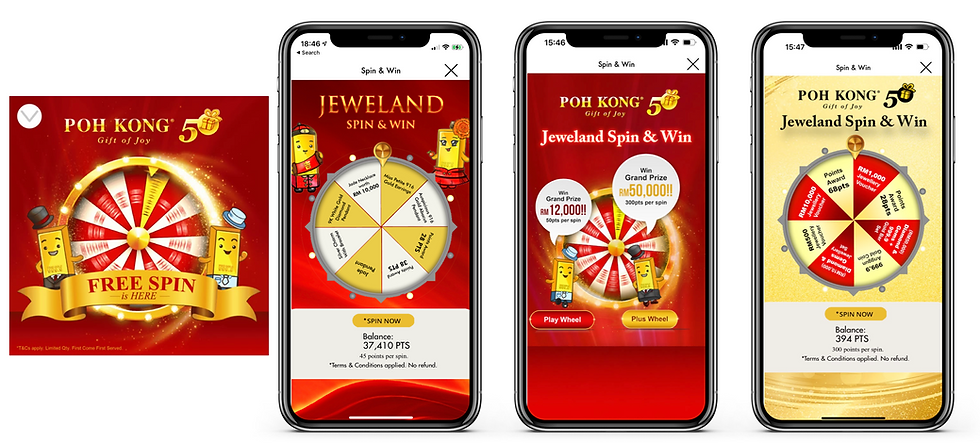
The busiest weeks in the Malaysian jewellery calendar are festive weeks. We run campaigns into them, including the nationwide Chinese New Year Spin & Win contest, turning peak footfall into enrolment, and enrolment into a database that is still paying off years later.
The mechanics that matter in jewellery
If you are building or buying a jewellery loyalty programme, these are the mechanics that decide whether it works. They are not the ones on a standard loyalty feature list.
Occasion recall, not interval recall
Generic platforms fire a message after a fixed number of days. In jewellery the trigger is the occasion. Someone who bought an anniversary piece is back in the market eleven months later, not at some arbitrary 90-day mark. The purchase date is a calendar entry, not a timestamp.
The purchase and certificate vault
Your customer cannot remember the carat, the grade or where the certificate went. If your programme holds that record, you are the shop they return to for the matching piece, the resize, the valuation and the trade-in. If you do not hold it, the shop that does gets that visit.
The gifting graph
In jewellery the buyer and the wearer are usually different people. Capturing who a piece was bought for turns one transaction into two relationships. Today's recipient is a buyer in three years, and the occasion that prompted the gift repeats annually.
Gold as an asset, not just a product
Trade-in, buy-back and the gold price are part of the category in a way they are not anywhere else in retail. When the price moves, footfall moves. A programme that treats a trade-in as a relationship moment, not just a till transaction, captures customers at exactly the point they are re-entering the market.
Trust, made visible
Nobody hands over RM20,000 to a business whose systems feel loose. Security, verifiable records and clean data handling are not back-office concerns in this category. They are part of the retail proposition.
The results
Scale. More than 700,000 members enrolled, and still growing steadily.
Reach. Around 100 outlets nationwide, across multiple store concepts, on one member record.
Basket value. Average tracked spend per member, per year, runs into four figures. A jewellery basket, not a coffee basket.
Longevity. Not a project with a handover date. An ongoing operating partnership measured in years.
The number that matters underneath all of this is not the member count. It is that a jewellery group can now see a customer whole: what they bought, across which store brand, for which occasion, and what they are likely to be back for.
Build a loyalty programme your business actually owns 700,000 members did not come from a points engine. It came from occasion-based mechanics, real POS and finance integration, and a team that sits in the marketing meeting every week. Tell us how many outlets you run and what POS you are on. We will show you what the first 90 days look like. |
Partner, not vendor: what the calendar actually looks like
Most loyalty vendors give you a login and a support inbox. The reason this programme kept compounding instead of stalling after launch is that Fireworks is inside the operating rhythm of the business.
Cadence | With whom | What happens |
Weekly | Client marketing team | Campaign planning, voucher mechanics, targeting, the festive calendar |
Bi-monthly | Client IT team | Infrastructure, integrations, security, roadmap |
Ongoing | Outlets | Counter support, so enrolment never stops on a Saturday |
Ongoing | Management | Strategy and commercial direction, not ticket triage |
Fireworks is a full-service company built around mission-critical retail chains. In practice that means three things a software vendor cannot sell you:
Branch support, not a ticket queue. Outlet staff are the ones enrolling members. If the counter flow breaks, enrolment stops that day. We support the branches directly.
Marketing people, not just engineers. Our team designs and runs campaigns alongside the client's marketing and CRM team. A platform nobody campaigns on is an expensive database.
Retail experience carried in. We have run this in jewellery, optical, department stores, malls and multi-brand retail. The playbook arrives with the platform instead of being discovered on your budget.
That combination, platform, branch operations, campaign capability and IT partnership under one roof, is why the infrastructure belongs to the client and the relationship is measured in years.
The number to look at in your own business
Ignore members for a moment. Count your anonymous transactions: the ones where nobody captured a name or a phone number.

In fashion that is a lost RM120. In jewellery it is a lost RM8,000 customer, plus the person the piece was bought for, plus the anniversary that repeats every year, plus the trade-in in five years' time. Every anonymous sale in this category is a customer you will have to pay to acquire again, at full price, if you ever get them back at all.
Seven questions before you buy any jewellery loyalty system
Does it pull the purchase and certificate record out of my POS automatically, or does my staff re-key it?
Can it fire a recall based on the occasion date, not a fixed 30 or 90-day interval?
Can it record who the piece was bought for, not only who paid?
Does trade-in and buy-back appear in the member's history, or does it fall outside the programme?
Does it reconcile into my finance system, or only into a marketing dashboard?
Do I own the infrastructure and the data, or does it live inside the vendor's platform?
Who runs the campaigns after go-live: my team alone, or does the vendor bring marketing people too?
If a vendor cannot answer the first three, they have built a coffee-shop loyalty app and pointed it at your jewellery business. If they cannot answer the sixth, you do not own your customer list. If they cannot answer the seventh, you have bought software and hired yourself as the operator.
Common questions
Do I need 100 outlets for this to make sense?
No. The mechanics that matter in jewellery, purchase and certificate capture, occasion-based recall and the gifting graph, pay off from a single store. What changes with scale is the reporting and campaign layer. We size the same platform for single boutiques and for national chains.
Will it connect to the POS I already use?
Usually yes. We build real-time two-way integrations into retail POS systems across several categories in Malaysia. If yours exposes an API or a database we can read, it can be wired. Where no integration exists, the platform runs standalone and syncs by file until one is built.
Who owns the data?
You do. We build infrastructure the client owns, with the database, the customer records and the export rights sitting on their side. This is the single most important question to ask any loyalty vendor, and the one most of them answer badly.
Can it handle gold trade-in and buy-back?
It should, and that is a design decision, not a plugin. Trade-in is the moment a jewellery customer re-enters the market. If your programme does not see it, you are blind at the exact point a competitor could take them.
What about PDPA?
Consent is captured at enrolment, data is encrypted, and the database belongs to the merchant. Hosting, backup and disaster recovery are specified per client rather than pooled with everyone else's data.
Who runs the programme after it goes live?
We do, alongside you. Fireworks is not a build-and-hand-over shop. Our marketing team sits with the client's marketing and CRM people on campaign design, voucher mechanics and targeting, and our technical team works with their IT team on the infrastructure they own.
Run this playbook in your jewellery business
Platform, branch support, campaign team and IT partnership in one place, built for retail chains where downtime is not an option. Tell us how many outlets you run and what POS you are on, and we will show you what this looks like sized for your business.
Talk to Fireworks Digital Enterprise loyalty, CRM and retail marketing for Southeast Asian retail chains. |


Comments